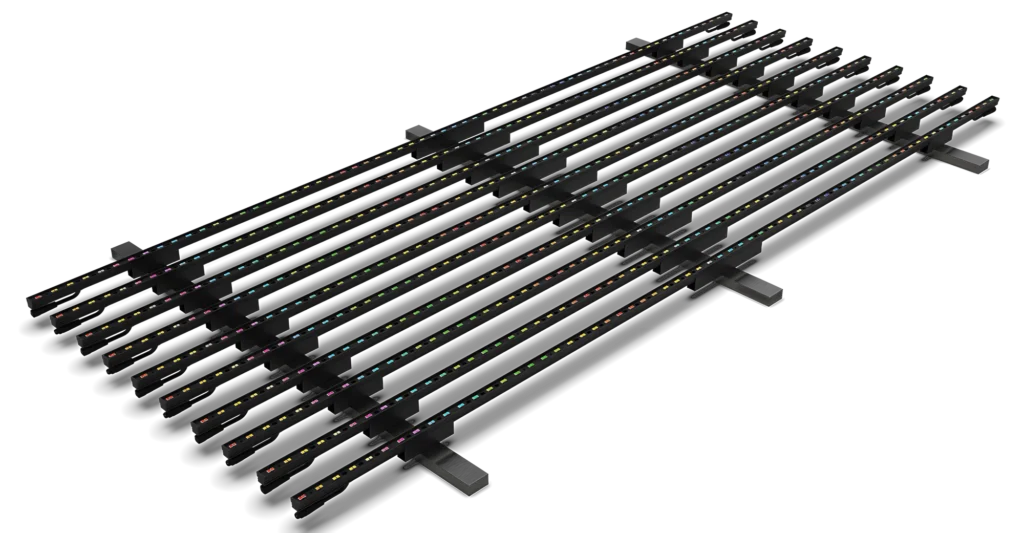
With a 62.5 mm pixel pitch, VMesh P16 is the most sparsely pixelated model in the VMesh family. This pitch is chosen for wide surfaces viewed from afar: stadium and shopping mall facades, tall blocks facing highways, landmark buildings seen from different parts of the city. The same area is covered with fewer pixels and lower power. Because the gaps between the bars stay open, the screen does not cover the facade: by day the building’s architecture remains visible, the interior receives daylight and the outside can be seen from inside.
Bar spacing determines transparency
The transparency of the screen depends on the distance between the bars and is set between 35% and 85%. When the bars are arranged 62.5 mm apart, the same as the pixel pitch, the pixels are square and 256 pixels per square meter are achieved; in this layout about 69% of the facade remains open. As the spacing widens, transparency increases and vertical resolution decreases. The right balance is determined by the viewing distance and the content to be played.
For exterior facade conditions
The anodized aluminum housing has IP68 water and dust protection and IK10 impact resistance; the screen operates between −30 °C and +65 °C. The slim 19.3 mm wide bars do not disrupt the lines of the facade. It draws 16 W per meter and is in energy class A++.
Control and mounting
The screen is controlled via SPI; video and graphic content is played pixel by pixel through a pixel map. The bars are attached to vertical support profiles with lockable mounting brackets; 500, 1000 and 2000 mm lengths are combined to build the screen to the size of the facade. We explain in detail how media mesh screens work in our article what is a media mesh LED screen.