Wall washer luminaires "wash" a wall or facade with even light from end to end. We explain how they work and how the lens angle and layout affect the result.
MMotto Aydınlatma
3 min read
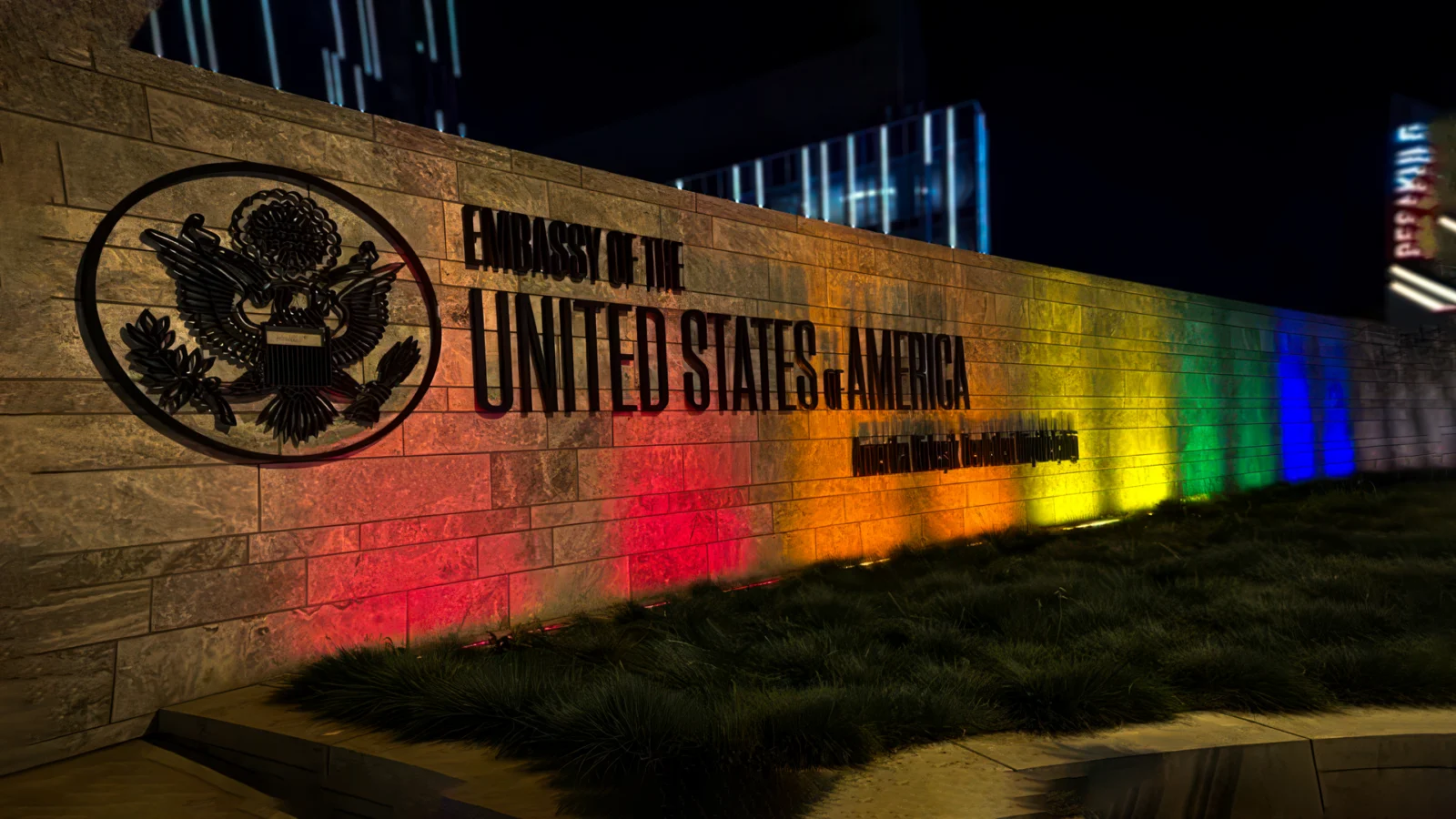
U.S. Embassy Ankara · Ankara
When you look at a building at night and see the facade lit as a whole, with even light and no patches, you are most likely watching wall washer luminaires at work. A wall washer, as the name suggests, is a luminaire that “washes” a wall with light, that is, lights a wide surface homogeneously.
What is a wall washer?
A wall washer is a luminaire, usually with a linear housing, whose lenses are designed to spread light along a surface. It is placed at the base of the facade, under the eaves or at a set distance from the wall, and directs light onto the surface. The aim is to achieve continuous, balanced illumination instead of individual pools of light.
The difference between wall washing and grazing
Two different effects can be achieved with the same luminaire. When the luminaire is moved a little away from the wall and light is sent onto the surface at a wider angle, the surface looks smooth and even; this is called wall washing. When the luminaire is placed very close to the wall and light travels across the surface at a grazing angle, textures such as stone, brick or plaster stand out together with their shadows; this is called grazing.
Washing is generally preferred on smooth, modern facades, and grazing on stone and historic facades whose texture is to be brought out.
How is the lens angle chosen?
The lens angle determines how wide a cone of light leaves the luminaire. The general rule is simple: the greater the height to be lit, the narrower the lens; the closer the luminaire is to the surface or the lower the height, the wider the lens angle chosen.
Lens angle
Light character
Typical use
10°–15°
Narrow light that travels far
Tall facades, columns, vertical accents
30°
Medium width
Facades of medium height
45°–60°
Wide
Low walls, washing from close range
90°
Very wide
Wide surfaces from close range
15°×40°, 22°×50°
Asymmetrical: narrow in one direction, wide in the other
Balanced washing of the wall from the base upward
The most reliable way to choose the right lens is a lighting calculation. A calculation or simulation using the facade height, the luminaire’s distance from the surface and the desired illuminance shows which angle will give a homogeneous result before you go on site.
Layout: distance, spacing and tilt
Distance from the wall: The closer the luminaire is to the surface, the more the light reveals texture; the farther away, the smoother the surface looks.
Tilt: By changing the luminaire’s angle with adjustable mounting brackets, the distribution of light on the surface is balanced.
Luminaire spacing: If too much space is left between luminaires, the light cones do not merge and arch-shaped patches (scallops) form on the surface. For an even look, luminaires should be lined up end to end or at intervals where the cones overlap.
Obstacles: Window projections, surrounds and eaves cast shadows. The layout should be planned on the facade drawings.
Glare: In installations close to pedestrian level, aiming should be done carefully so the light does not shine into people’s eyes.
Which light color?
Wall washer luminaires can be made in single color (MC), dynamic white (DW), RGB and RGBW. Warm white is preferred on stone and historic facades; neutral or cool white on modern buildings dominated by glass and metal; RGB or RGBW on buildings where color scenarios are wanted. We compare the options in our light color article.
Motto wall washer luminaires
Our MiniRado and ColloRado wall washer luminaires are made with different lens angles and MC, DW, RGB and RGBW light options; angled mounting brackets let the angle of incidence of the light be adjusted precisely. Their in-ground versions, placed in the ground, wash the facade from the base upward with 15°, 30°, 45°, 60° and 90° symmetrical lenses as well as 15°×40° and 22°×50° asymmetrical lens options; they have IP68 water and dust protection and IK10 impact resistance.
We can determine together the lens and layout that suit your facade’s height and material.