Pixel-controlled point luminaire

PixiDot

PixiDot is a pixel-controlled point LED luminaire (dot LED) with every dot controlled individually. The dots are strung on a flexible cable at 12.5, 25 or 50 cm intervals; it forms a grid on flat facades and a free pattern on curved surfaces.

  • Point pixel
  • 125–500 mm pitch
  • IP68 · IK10
  • SPI / DMX512

Light option

Datasheets

  • 24V DC
  • 48V DC
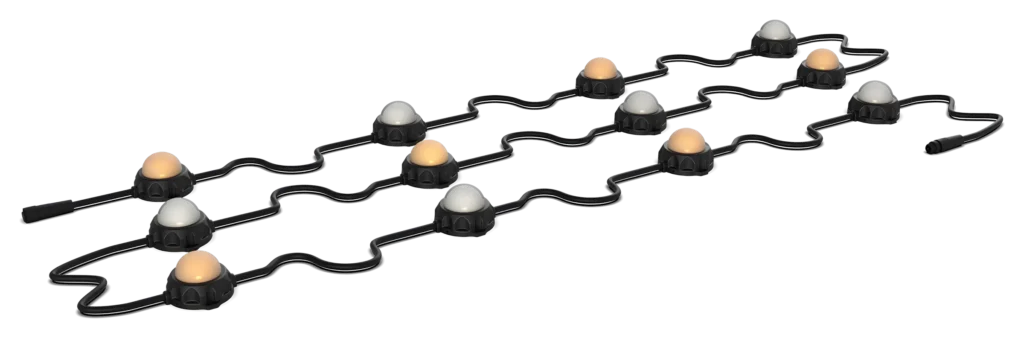
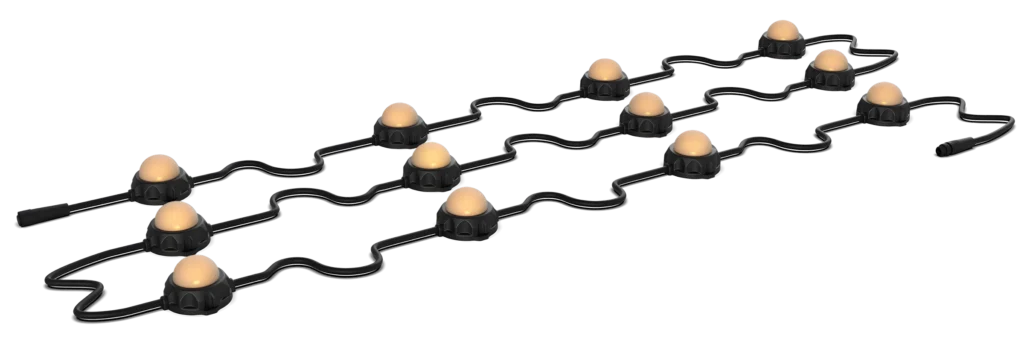
PixiDot MC (single color) pixel-controlled point luminaire, switched on
PixiDot DW (dynamic white) pixel-controlled point luminaire, switched on
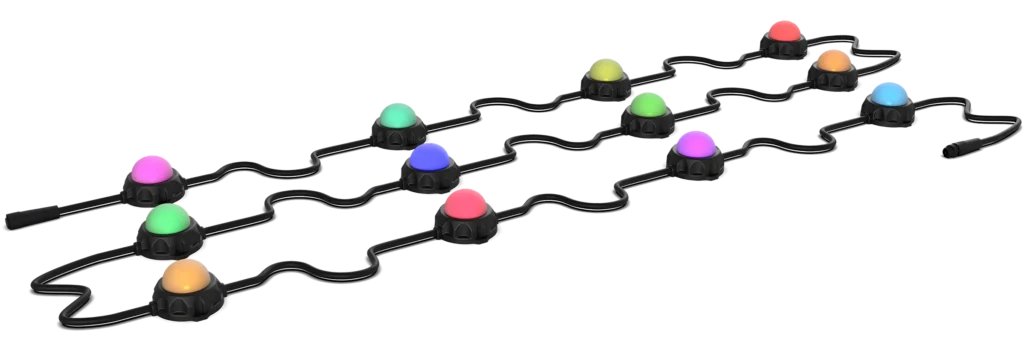
PixiDot RGB (color) pixel-controlled point luminaire, switched on
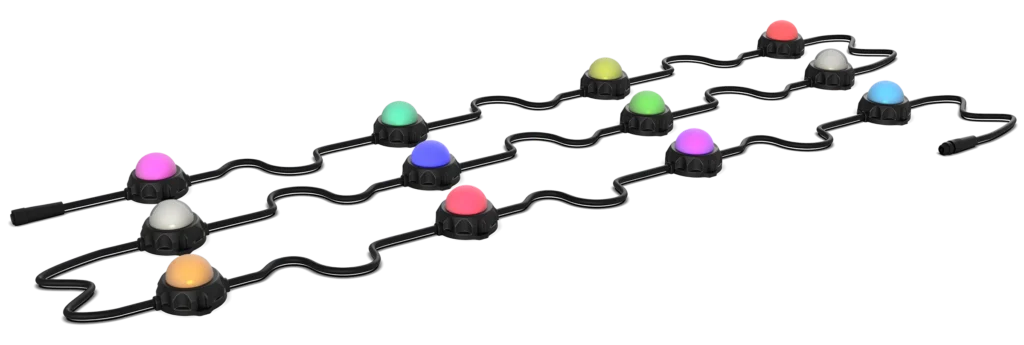
PixiDot RGBW (color + white) pixel-controlled point luminaire, switched on

RGB · Color · 5050 3-in-1 RGB SMD LED

LEDs / dot
6
cm minimum pitch
12,5
dots per string, max.
100
light options
4

Technical specifications

Light

LED specifications
High efficiency, LM-80 compliant · L90B50 > 60,000 hours
LED count
6 LEDs in every dot
Dot spacing
12.5 · 25 · 50 cm (standard) · project-specific pitch
Dots per string
1 · 10 · 25 · 50 · 100

Electrical

Input voltage
24 V DC (standard) · 48 V DC (optional)
Control
SPI (standard) · DMX512 (optional)
Safety class
Class III
Energy class
A++

Mechanical

Housing
UV-protected ABS
Diffuser
UV-protected, high-transmittance polycarbonate
Dot dimensions
69.84 × 80.75 mm · height 38.65 mm
Mounting
Flexible cable; flat and curved surfaces
Housing color
RAL 9005 · RAL 9016 · RAL 9006

Environment

Protection rating
IP68
Impact resistance
IK10
Operating temperature
−30 °C … +65 °C
Certifications
CE · RoHS

By option

LED type
5050 3-in-1 RGB SMD LED
Light color
Red, Green, Blue, Mixes
Channels per pixel
3
Power
1.5 W/nokta
Luminous flux
31.5 lm/nokta

Try the colors

PixiDot dots are arranged on the facade like a grid; each dot is a separate pixel. Choose the dot spacing and the effect.

RGB Color

Red, green and blue combine in a single LED package; each dot shows its own color separately. Together the dots create color waves, flowing patterns and simple graphics; on special days the facade glows in corporate or flag colors.

Effect

Dot spacing

The animation uses screen colors; the real light color and brightness differ from your screen.

Product codes

The codes are standard strings; dot spacing and the number of dots per string are changed to suit the project. Click a code to copy it.

PixiDot RGB (color) product codes
Product code Number of dots Spacing LED Power Luminous flux
1 12.5 cm 6 1.5 W 31.5 lm
10 12.5 cm 60 15 W 315 lm
25 12.5 cm 150 37.5 W 787 lm
50 12.5 cm 300 75 W 1,575 lm
100 12.5 cm 600 150 W 3,150 lm

Housing and mounting

Housing color · RAL 9005

Mounting layout

12.5 · 25 · 50 cm

The dots are strung on a flexible cable; a grid is formed on a flat facade and a free pattern on a curved surface. Strings are joined by the connectors at their ends.

Dot dimensions

84 69 80 mm

Frequently asked questions about PixiDot

If you can't find the answer to your question, write to our technical team.

What is the distance between dots on PixiDot?

Standard intervals are 12.5, 25 and 50 cm; other intervals are made to suit the project. At a 12.5 cm pitch there are 64 dots per square meter, at 25 cm 16, at 50 cm 4. The pitch is chosen according to the viewing distance and the pattern to be created on the facade.

How many dots are in a string, and can strings be joined?

Strings are made with 1, 10, 25, 50 and 100 dots; the product code shows the number of dots in the string. Strings are joined by the connectors at their ends to build longer runs and large grids.

What is the difference between MC, DW, RGB and RGBW?

The housing and string structure are the same; the difference is the LED inside the dot. MC produces a single light color, DW a white that varies between warm and cool, RGB color mixes, and RGBW pure white in addition to colors. The number of channels per dot is 1 for MC, 3 for DW and RGB, and 4 for RGBW.

What is the power and luminous flux of one dot?

One dot draws 1.5 W in the MC, DW and RGB versions and 2 W in the RGBW version. Luminous flux per dot is 67.5 lm for MC, 60 lm for DW, 31.5 lm for RGB and 56 lm for RGBW.

Can it be applied to curved surfaces?

Yes. Since the dots are strung on a flexible cable, they are mounted following the surface on domes, arches and curved facades. It is also used together with pixel-controlled linear luminaires on the same facade.

Should I choose SPI or DMX512?

The standard version runs on SPI and is powered at 24 V DC. A DMX512 version is made for projects connecting to an existing DMX512 infrastructure, and a 48 V DC power option for long runs.

Message us on WhatsApp