DMX512 is the digital control standard that manages lights from a single center in a coordinated way. We explain how it works, addressing and the rules for building a healthy DMX line.
MMotto Aydınlatma
4 min read
Hilton DoubleTree · Manisa
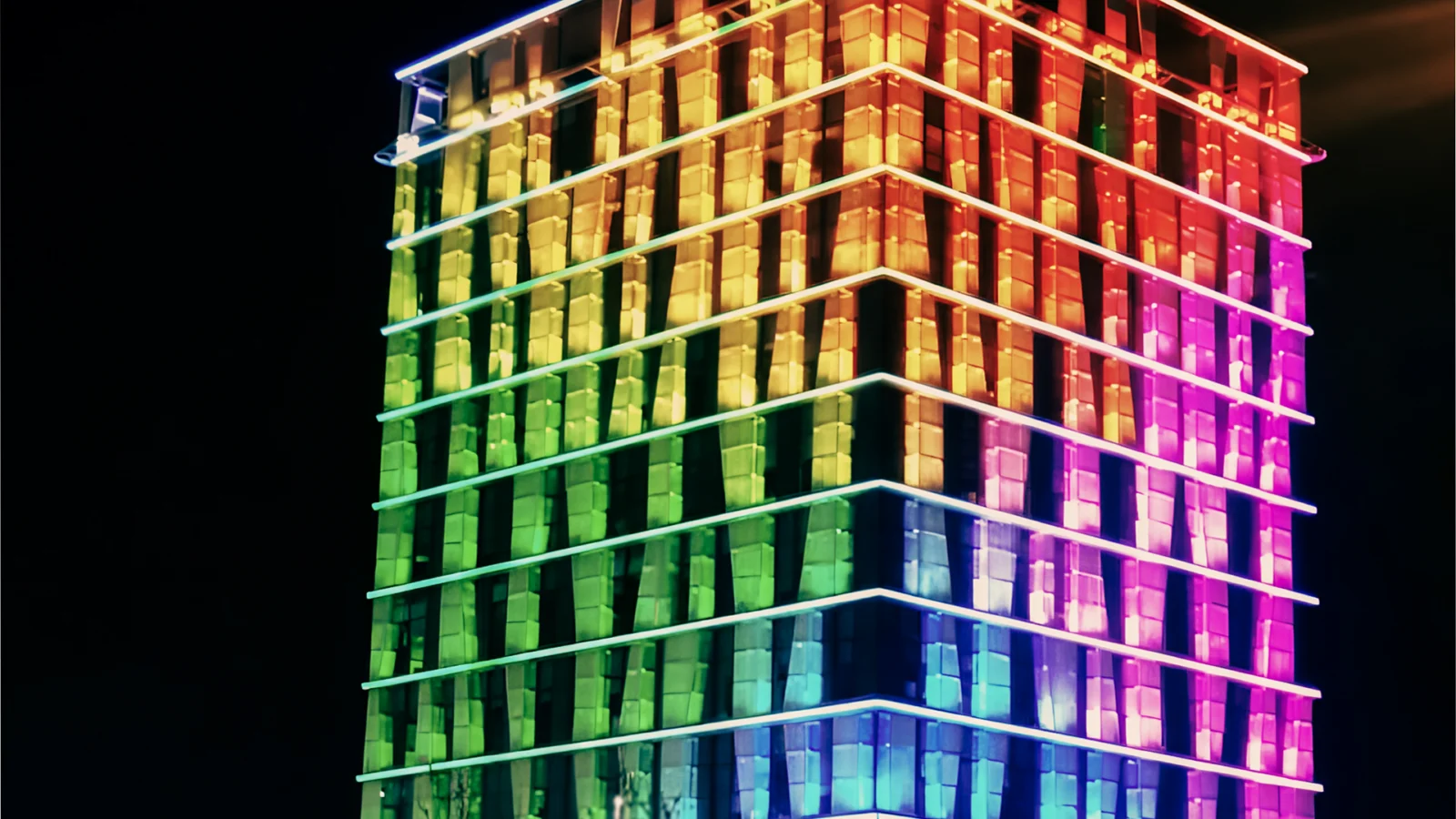
Hundreds of luminaires on a facade changing color at the same time, light flowing like a wave from one end to the other, or a different scenario starting at a set time every night… Behind all of these is a control system that tells the luminaires what to do. In architectural lighting, the most common language for this job is DMX512.
In this article we explain what DMX512 is, the concepts of channel and universe, how addressing is done and what to watch for to build a healthy DMX line.
What is DMX512?
DMX512 (Digital Multiplex) is a communication standard developed to control lighting devices digitally. It emerged in 1986 for stage lighting; today it is standardized as ANSI E1.11 (DMX512-A) and used in a very wide range of fields, from the stage to architectural lighting.
The 512 in its name is the number of channels that can be carried on a single line. Each channel carries a value between 0 and 255; the luminaire converts this value into a light intensity or a color component. 0 means off, 255 full brightness.
Channel, address and universe
The easiest way to understand DMX is to think of three concepts together:
Channel: A single controlled value. The brightness of a single-color luminaire is one channel; an RGB luminaire has three separate channels for red, green and blue.
Address: The first channel the luminaire starts listening to. An RGB luminaire with start address 1 uses channels 1, 2 and 3; the next one is given address 4.
Universe: A DMX line of 512 channels. In projects whose channel needs exceed 512, more than one universe is used.
The number of channels depends on how many colors and how many separate sections (pixels) the luminaire controls. The table below shows the maximum number of pixels that fit in a single universe:
Light type
Channels per pixel
Max. pixels per universe
MC (single color)
1
512
DW (tunable white)
2
256
RGB
3
170
RGBW
4
128
On a pixel-controlled facade the channel count grows quickly: after 170 RGB pixels a second universe is needed. That is why in large projects universes are carried over Ethernet with the Art-Net or sACN protocols. We explain the details in our control signal article.
How does DMX work?
On a DMX line, data flows in one direction, from the control device to the luminaires. The control device (a lighting console, computer software or a wall-mounted controller) sends the values of all channels one after another, continuously. Each luminaire reads the values at its own address and ignores the rest.
Electrically, DMX uses a differential signal structure called RS-485. Because data is carried as the voltage difference between two wires, it is resistant to external interference and works reliably over long cables. The data rate is 250 kbit/s; when all 512 channels are sent, the whole line is refreshed about 44 times per second. This is enough for smooth transitions that look seamless to the eye.
How is a DMX line set up?
A healthy DMX line has a few basic rules. Most faults encountered in the field come from skipping these rules:
Daisy-chain connection: Luminaires are connected to one another in sequence; the line is not branched in a star shape. If branching is needed, a DMX splitter is used.
The right cable: A 120-ohm impedance, twisted-pair and preferably shielded data cable is used. Ordinary power cable is not suitable for the data line.
Termination: A 120-ohm termination resistor is fitted after the last luminaire on the line. On unterminated lines the signal reflects; lights may flicker or behave randomly.
Device count and distance: It is recommended that no more than 32 devices be connected to one DMX segment and that the line length not exceed 300 meters. For more, an amplifier or splitter is added.
Address plan: Addresses are planned in a table before installation and labeled on the luminaires. This makes maintenance and later changes easier.
The 5-pin XLR is the standard connector on stage equipment; facade luminaires usually use special waterproof connectors or terminal connections.
RDM: the two-way form of DMX
In classic DMX, data only goes to the luminaire; no information comes back from it. RDM (Remote Device Management, ANSI E1.20) provides two-way communication over the same cable. RDM-enabled luminaires can be addressed remotely, and status information such as temperature or faults can be read from the control point. For facade luminaires mounted high up or in hard-to-reach places, this is a great convenience.
What does DMX offer in architectural lighting?
Synchronization: Hundreds of luminaires move from a single center, at the same time and with the same timing.
Scenarios: Different color and motion scenarios can be prepared for holidays, special days or weekends and linked to a calendar.
Remote adjustment: Light level and color are changed from the software without touching the luminaires.
Open standard: Because DMX is an open standard, control devices and luminaires from different manufacturers can work together.
DMX512 in Motto luminaires
Many of our dynamic white (DW), RGB and RGBW luminaires work with the DMX512 control protocol; color, white tone and light level are managed from a single center. For example, the DW, RGB and RGBW versions of the ColloRado and MiniRado families among our in-ground luminaires are controlled via DMX512. Our pixel-controlled linear luminaires can be ordered with SPI as standard and the DMX512 protocol as an option. We compare the two protocols in our SPI pixel control article.
We can work out together how many universes your project will need, which control device is suitable and the address plan.